Bioprospecting unearths microalga for third-gen biofuels
South Australian researchers have isolated and evaluated a ‘super strain’ of a native microalgae species that could form the basis of a local biofuels industry.
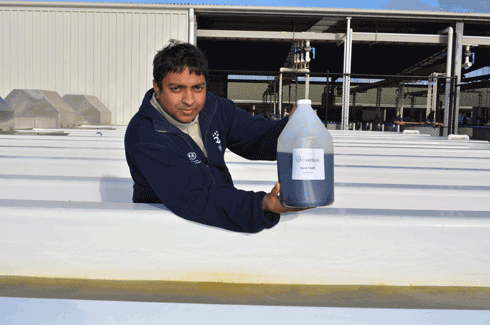
SARDI researcher Dr Sasi Nayar with biofuel extracted from a ‘super strain’ of the Nannochloropsis green alga, which has high lipid and protein content.
Credit:
SARDI
The South Australian Research and Development Institute (SARDI) team, led by Dr Sasi Nayar, says the breakthrough comes after six years of ‘bioprospecting’ across thousands of kilometres of the State and into the waters of the Great Australian Bight followed by laboratory and small-scale outdoor raceway trials.
The success in finding this particular strain of microalgae among the hundreds of microalgal species and strains evaluated has given South Australia a head start as research into ‘third generation’ biofuels advances to the next level.
SARDI’s production trials are part of a $4.2 million microalgae biorefinery project funded by the South Australian Government and project partners SARDI, Flinders University, United Water, Flinders Partners and Plentex Ltd.
Dr Nayar says the research team successfully isolated 14 native strains with potential. ‘The flagship strain stands head and shoulders above the rest – it is a specific strain of Nannochloropsis (a green alga), with an unusually high lipid and protein content.
‘These attributes mean that the microalgae has tremendous commercial potential with application across the full range of oil uses from biofuels to high value co-products such as animal and human food supplements, nutraceuticals and cosmeceuticals such as skin cream and anti-ageing creams.
‘We are at a stage where we now know a lot about this species and its optimal growing conditions and we are ready to scale up to commercial level to refine the production systems to be used.’
The research partners are now looking for investors to help take the research to commercial pilot scale and then full commercial scale.
As a non-food feedstock, microalgae sources do not compete with traditional agriculture for land and resources. It produces a clean, renewable fuel that opens the door to significantly reducing greenhouse gas emissions.
Researchers say the process is carbon neutral because the microalgae absorb or recycle carbon as they grow.
The mining industry is one of the largest users of diesel in Australia, and biofuel derived from microalgae provides one of the best alternatives to petroleum-derived fuel for the aviation and vehicle industries.
More than 300 delegates from 27 countries attended last week’s ‘Algae for the Future’ conference at which the research findings were presented.
Source: SARDI
Published: 25 November 2014
Things warm up as the East Australian Current heads south
JaciBrown
Occasional erratic bursts southward of the East Australian Current (EAC) are thought to have moderated the weather of south-east Australia this autumn and winter and they continue to introduce tropical and sub-tropical marine species to Tasmanian waters.
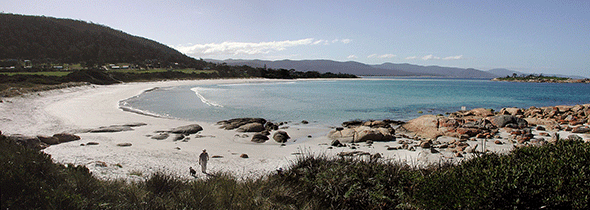
Tasmania’s east coast: tropical and sub-tropical marine species normally found off NSW are finding their way further south, thanks to changes in the East Australian Current.
Ocean monitoring by Australia’s Integrated Marine Observing System is providing scientists with significant new insights into the changing structure of the EAC. Over the past 50 years sporadic warm bursts have become more common as the EAC moves further south. With global warming, the warm burst we’ve seen this year may also become the norm.
Had our little friend Nemo the clownfish been riding the EAC this year he might have found himself holidaying in Tasmania rather than admiring the Sydney Opera House. He wouldn’t have been on the trip alone, though. Sea nettles (Chrysaora spp.) have headed from their usual home in Sydney to be found for the first time ever in Tasmania and the Gippsland Lakes.
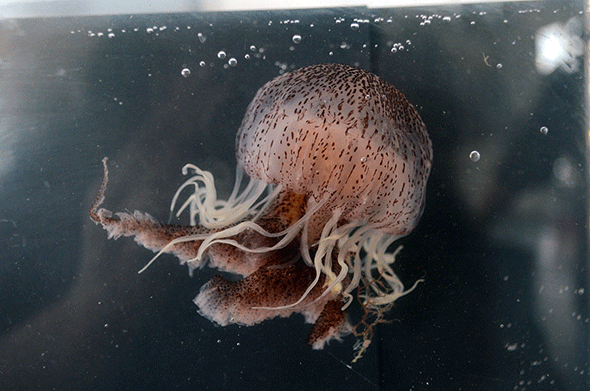
Chrysaora woodbridge, or sea nettle, was found in surprising numbers in Tasmania this year.
Credit: copyright Lisa-ann Gershwin
Waters in the EAC travel southward along the east coast of Australia, with most of it splitting from the coast near Sydney and heading for New Zealand. A small part of the current, known as the EAC Extension, works its way southward past Victoria and Tasmania.
A typical signature in this region are the large eddies, around 200 kilometres across and hundreds of metres deep. Some of the warm water is trapped here along with marine life.
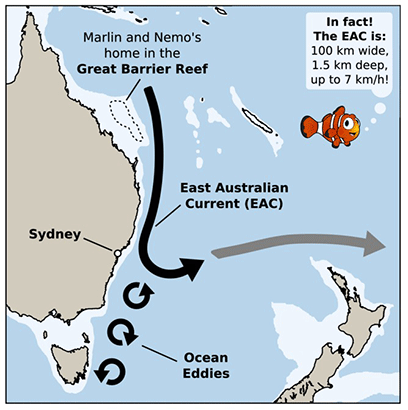
The EAC starts at the Great Barrier Reef and travels south to Sydney before turning eastward to New Zealand. Some of the water can still push southward via a series of strong eddies.
Credit: Eric Oliver
This year a larger proportion of the EAC was sent southward instead of breaking away to the east. Winter ocean temperatures off Bass Strait were around 19°C, an increase of 4°C. This impacted local fishing, beach conditions and the weather.
In the video (above) the animation on the left shows the actual sea surface temperature and speed of the ocean currents. The animation on the right shows the difference in the temperature from average conditions.
Through autumn and winter, you can see two interesting changes occur. A strong warm current heads down the coast from Sydney to the coast of Victoria. At the same time, warm water peels off from the EAC and swirls around in large eddies as it meanders toward Tasmania.
An unusual catch down south
One advantage of warm eddies is the refuge they provide for tuna. They congregate in the centre of the eddy where the waters are warm and dine at the nutrient-rich edges.
Local fishers in north-east Tasmania report a remarkable year that allowed them to fish longer than usual, providing game fishers with more opportunities to catch tuna.
Last summer’s (2013–2014) warmth provided an abundance of skipjack and striped marlin, while winter brought a run of bluefin tuna.
Redmap is a website where locals can report sightings of marine species that are unusual for a given area.
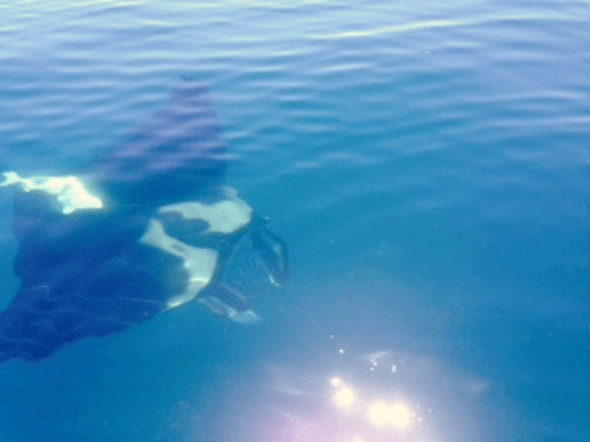
Last summer a manta ray, a tropical cartilaginous fish (in a group including rays and skates), was sighted off the north-eastern coast of Tasmania. Previously the southern-most sighting of a manta ray was just south of Sydney.
Manta birostris spotted off north-east Tasmania on Australia Day 2014.
It’s not just new species visiting Tassie either. Local jellyfish such as the Lion’s Mane (Cyanea) – more commonly known as ‘snotty’ – are usually quite elusive, but turned up in unprecedented numbers last summer in Tasmania.
But there’s a catch
This movement south of the EAC may have an impact on other systems, including our health. We rely on fish such as those from the Tasman Sea as a source of omega-3 fatty acids for our brain health. But the concentration of omega-3 fatty acids in the fish is likely to decrease with global warming.
Algae are the original source of fatty acids. As our waters warm, we will see more of the algae from the tropics take up residence in the south-east.
But the algae from the tropics are much smaller, which means more steps in the food chain from the algae to the fish we eat. The more steps in the food chain, the more the omega-3 fatty acids in the fish are replaced by fatty acids that are less favourable to brain health.
The warmer coastal waters also contributed to the balmy autumn and winter in south-eastern Australia this year. Afternoon sea breezes cool coastal temperatures by drawing cool oceanic air onto the coast.
Sydney’s heat wave in May this year had 19 consecutive days of 22°C or more – this is partly due to the sea breezes failing to bring in the usual cooling air.
What’s causing the EAC to move south?
Over the past 50 years the EAC Extension has stretched about 350 km further south. This extension doesn’t happen smoothly but in erratic bursts.
The southward extent of the EAC is controlled by the collective behaviour of the winds between Australia and South America. Over that same 50-year period these winds changed their pattern due to a strengthening of a climate system known as the Southern Annular Mode.
The changes to this mode have been attributed to a combination of ozone depletion and increasing atmospheric CO2.
One of the most robust and consistent responses of the climate system to increasing CO2 is a further strengthening of the Southern Annular Mode.
So the result will likely be a further enhancement of the EAC extension southward and even warmer waters in the Tasman Sea.
Dr Jaci Brown is a senior research scientist with the Centre for Australian Weather and Climate Research (CAWCR), a partnership between CSIRO and the Bureau of Meteorology. Her research focuses on the El Nino Southern Oscillation (ENSO) and climate change. This article was originally published on The Conversation. Read the original article.
ECOS Archive
Welcome to the ECOS Archive site which brings together 40 years of sustainability articles from 1974-2014.
For more recent ECOS articles visit the blog. You can also sign up to the email alert or RSS feed