In this issue
 |
 |
ECOS
Issue 122
|
| |
|
|
Misima mine damage raises concerns
Canadian-based resources company Placer Dome is drawing international attention for the impact of its gold and silver mine on the tiny Papua New Guinean island of Misima. As Placer Dome prepares to decommission its operations, indigenous landowners have sent out a plea for support to have the company called to account for the mine's environmental and community effects.
Download Article
|
|
| |
|
Indigenous managers for dugong and turtle harvests
With new concerns over excessive traditional hunting of dugongs and turtles in the Torres Strait, an assessment will be undertaken of their harvest, and a $3.8 million federal contract has been signed with the North Australian Indigenous Land and Sea Management Alliance (NAILSMA) to develop community-driven approaches to sustainable management of the animals.
Download Article
|
|
| |
|
A guide to managing biodiversity impacts under climate change
The release by the Natural Resource Management Ministerial Council of an action plan to help natural resource managers deal with the impacts of climate change on biodiversity is significant. It confirms we have accepted that real and possibly dramatic effects for Australia's biodiversity from climate change lie ahead, and that coordinated action will be needed to assist agencies to mitigate these effects.
Download Article
|
|
| |
|
The Aquadam
Could a radical Australian idea for floating self-powered desalination reservoirs be a timely solution for water supplies, changing the way we handle water on land? Enter the 'Aquadam Project' - a starkly innovative scheme to capture and store rainwater, stormwater and desalinated seawater in a flexible, floating dam sited some 2 to 5 km out to sea. A guaranteed supply of purified water will then be piped to neighbouring cities or towns, easing the growing burden on catchments and rivers.
Download Article
|
|
| |
|
Returning the lifeblood to rivers
The emerging science of environmental flows is providing overwhelming evidence of the damage inflicted on Australian rivers and estuaries, and is now developing solutions to restore river environments. These advances underpin new national policy and regional action plans aimed at restoring and protecting the country's rivers and estuaries.
Download Article
|
|
| |
|
How healthy river habitats suffer from altered flows
The journey from pristine and unmanaged rivers to today's heavily exploited waterways is largely a story of social and economic values that favoured irrigated agriculture and flow regulation over the natural resources of rivers. Now, even limited restoration is socially, financially and politically challenging.
Download Article
|
|
| |
|
Clever planning and management approaches
The complex management of environmental flows to improve river health takes time. It can take 10, 50 or even 100 years before environmental responses show up, so the question is, what management strategy do we adopt in the meantime?
Download Article
|
|
| |
|
Where wild things are dammed
Growing protests surrounding the Paradise Dam project under construction on the Burnett River in south-east Queensland illustrate the public's concern that both federal and state governments can still override sustainable development priorities, conservation legislation, community consultation, and expert scientific knowledge, for the sake of local economic growth and political expediency. They also question the necessity for the more dams on Australia's remaining untamed rivers.
Download Article
|
|
| |
|
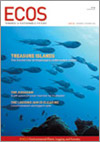
Treasure islands
The Recherche Archipelago is regarded one of Australia's most spectacular seascapes. Now, after the community of Esperance stood up to initiate a major scientific investigation of its vulnerable underwater habitats, this rugged chain of landmasses off Western Australia's southeast coast is becoming noted for its remarkable biodiversity.
Download Article
|
|
| |
|
The long white cloud over New Zealand's forests
New Zealand has a dark history of massive deforestation and biodiversity loss over the last 1000 years. Even today, although governments have introduced progressive conservation measures through legislation since the early since the 1970s, logging of indigenous forest quietly continues, and exotic species are over-running native ecosystems. New Zealand has a big challenge on its hands.
Download Article
|
|
| |
|
Letting the locals lead
Over the last twenty years, governments in Australia have been urgently developing new approaches to sustainable natural resource management (NRM). Building on some successful independent examples, cooperative regional scale governance has emerged as the preferred approach in Australia for addressing broad sustainability challenges.
Download Article
|
|
| |
|
Safari hunting - in Australia?
Most parts of Australia are cursed with at least a few species of feral animals and some people have a passion for hunting such game. Put the two together and you have a safari hunting industry. However, it's not really that simple. There are ethical and animal welfare concerns, conflicting interests, government regulations, possibly a need for new infrastructure and conservation, management and economic considerations.
Download Article
|
|
| |
|
Improving the weak assessments of GMO risks
Having identified the lack of a coordinated and fully rigorous international approach to measuring the potential effects of Genetically Modified Organisms (GMOs), CSIRO scientists have been working on improving the way we assess the environmental risks associated with their release.


Download Article
|
|
| |
|
Sharks could save lives
Shark populations are declining around the world, but their value to science, and the enormous potential value of biocompounds to us generally, have been reaffirmed now researchers have discovered that sharks' unique antibodies may help diagnose a wide range of human diseases.
Download Article
|
|
| |
|
| |
|
|