In this issue
 |
 |
ECOS
Issue 124
|
| |
|
|
Editorial - Editorial of an Issue
Greenhouse gas levels in reach with action and new technology
While findings by the Cooperative Research Centre for Greenhouse Gas Technologies have suggested that action must taken within the next ten years to stabilise global levels of atmospheric CO2 by the end of the century, they also highlighted that with current technologies and practices this can actually be achieved.
Download Article
|
|
| |
|
More Perth residents TravelSmart
Western Australia continues with its encouraging and proactive assessment of sustainable alternatives. The Department for Planning and Infrastructure's TravelSmart programme trial in the Perth suburb of Armadale, where more than 7000 residents took part, shows their commitment to exploring transport alternatives.
Download Article
|
|
| |
|
Climate network underway
A huge climate-observing network across the Indian Ocean aims to monitor ocean currents and temperature and understand the conditions that bring rain and drought to nearly two-thirds of the world's population.
Download Article
|
|
| |
|
A united plan for the Mekong
Two of the world's greatest wetland areas along South-East Asia's majestic Mekong River are under threat from new, external forces barely understood by the traditional cultures of the region. The IUCN, the World Conservation Union, has recently launched an ambitious cross-border program aimed at both staving-off the fastest growing pressures, and ushering in a new era of sustainable livelihoods.
Download Article
|
|
| |
|
Simple faith from a green revolutionary
Despite pervasive concerns, both public and political, of the potentially unknown effects of genetically engineered crops, the revered 80-year-old Indian plant geneticist, Professor MS Swaminathan, is convinced by his achievements that genetic technology is the timely answer to feeding the world's increasing population. Anna King Murdoch reports on the experience of a man credited with feeding 70 million people.
Download Article
|
|
| |
|
Reign of fire
With recent strides made in understanding the complex ecological cycles of our rainforests, scientists are now better aware of the severe effects of both climate change and creeping development on forest ecosystems. Julian Cribb reports on a growing call for an urgent change to management thinking and practice for rainforest areas.
Download Article
|
|
| |
|
Making water — hold the salt
Desalination technology is becoming more efficient, and more feasible. Proponents say it now makes good sense in Australia, but critics argue that wider environmental impacts must still be taken into account.
Download Article
|
|
| |
|
Sun-power technology centre underway
Construction of CSIRO's $1.5 million National Solar Energy Technology Centre (NSETC) is underway at its Newcastle Energy facility, where the latest solar thermal technologies will be showcased and involved in CSIRO's ongoing collaborative research into efficient, low emission energy generation.
Download Article
|
|
| |
|
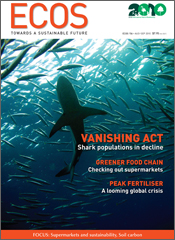
A Stirling idea
An innovative Australian spin on the simple age-old technology of the Stirling engine could be the answer to one of our region's more pressing problems the need for a cheap, portable, low maintenance renewable energy unit. The economical 'solar Stirling' generator is all the more remarkable for its combined desalination and heating or cooling capacity.
Download Article
|
|
| |
|
Amazon isotope discovery should sharpen climate predictions
While studying the cycle of water in the Amazon Basin, Professor Ann Henderson- Sellers, of the Australian Nuclear Science and Technology Organisation (ANSTO), and Dr Kendal McGuffie, of the University of Technology Sydney, have developed crucial new insight into deforestation's link to water and climatic cycles, and global warming. Their findings could provide the first independent test of current Global Climate Models (GCMs).


Download Article
|
|
| |
|
Growing fuel from algae
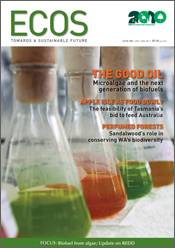
Toxic algal blooms have given algae a bad name in Australia but, on the whole, this poor reputation is not deserved. Much maligned microalgae are in fact the principal primary producers in aquatic ecosystems, the basis of aquatic food chains. Now, thanks to recent research, particular microalgae are being seriously looked at as a plentiful future source of renewable biofuels as well.
Download Article
|
|
| |
|
A new bacterium may be associated with reef bleaching
Israeli researchers who discovered that a bacterium is implicated in bleaching of at least one coral species overseas have recently worked with James Cook University scientists to help identify a possible new Australian strain. While further research is now underway to determine whether or not the find may provide important information about why the Great Barrier Reef's corals bleach, the bacterium's interaction with corals around the world has been illuminating in itself for marine science.
Download Article
|
|
| |
|
| |
|
|