In this issue
 |
 |
ECOS
Issue 133
|
| |
|
|
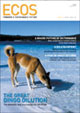
Call for more dingoes to restore native species
Reintroducing more dingoes to Australia would help control the population of nuisance pests and restore some of the country's dwindling native species populations, according to research by Professor Chris Johnson from the School of Marine & Tropical Biology at James Cook University.
Download Article
|
|
| |
|
The mechanics of social change
Rarely before has society had to consider the prospect of changing its ways so wholly and quickly as it does with the currently emerging environmental priorities. On a global scale, it has never happened. The big question is how do we get society to quickly take a radically different path, and what are the mechanisms behind such a shift?
Download Article
|
|
| |
|
WA's mining boom: where does it leave the environment?
Western Australia is in the grip of its biggest-ever mining boom. The economy is buoyant and unemployment is at a record low; however, all this activity is occurring amongst internationally unique landscapes and biodiversity - which leads to the question, when commodity prices inevitably fall, what will be the legacy of the boom on WA's famous natural environment?
Download Article
|
|
| |
|
Queensland's dam strategy raises bigger questions
In April this year, against recommendations and protests, the Queensland Government announced the construction of a new mega-dam on the Mary River, some 16 km south of Gympie. While proponents see the project as a necessary investment in south-east Queensland's water supply, opponents are incensed about another dam project's seeming disregard for due process and independent findings of both its infeasibility and negative environmental impacts.
Download Article
|
|
| |
|
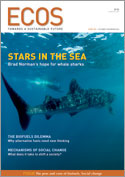
Stars in the sea
Driven by a love of the sea and its largest fish, the elusive whale shark, Australian naturalist Brad Norman has created a worldwide photo-identification system which enables ordinary people to assist in its conservation. In recognition of his contribution to the understanding of the threatened shark, Norman has become the first Australian Laureate of the Rolex Awards for Enterprise in 25 years.
Download Article
|
|
| |
|
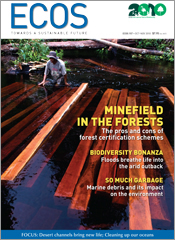
The biofuels promise: updated thinking
Biofuels seem an obvious alternative given the recent surge in fossil fuel prices and more emphasis on environmental impacts. However there are some serious implications of biofuels' wider use that need deeper consideration.
Download Article
|
|
| |
|
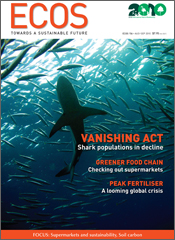
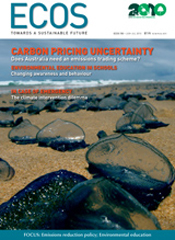
New approaches for traditional ways
Things are looking up for the traditional villagers around Bach Ma National Park in Vietnam's highlands. A cooperative international project is teaching them new farming methods that both help preserve their protected region and increase their incomes.
Download Article
|
|
| |
|
Safeguarding dangerous shores
In nature, some things are best left alone, buried well beneath the surface. But housing, marina and infrastructure developments frequently disturb coastal acid sulfate soils and sediments, sometimes with disastrous consequences. Now a national atlas is providing a clearer picture of the extent and severity of this phenomenon along Australia's coastline.
Download Article
|
|
| |
|
Review - Nuts and bolts of sustainability online
Sustainable Development Online (SDO) is a growing, submissions-based international reference database and part of EnviroWindows, an environmental information website. Ecological Internet (EI) is a slightly different portal for environmental sustainability news, expert analysis and information retrieval tools.
Download Article
|
|
| |
|
Naturally regrowing eucalypts is a challenge
Large areas of Australia's grazing lands now need restocking with native vegetation in order to restore the integrity of the landscape and recharge ecosystems. But while 'natural regeneration' of eucalypts is typically relatively cheap for farmers compared with direct seeding or planting tubes, research shows that natural regeneration is fickle and can involve some risk in the allocation of resources to it.


Download Article
|
|
| |
|
Algae bioreactors that tackle CO2 emissions
An Australian company is assessing an innovative, natural system for reducing CO2 emissions right at their source, before they hit the atmosphere. Using NASA inspired research, the technique utilises the carbon-fixing abilities of single-celled algae, cultured in specially designed bioreactors, to consume carbon dioxide and nitrogen oxide at their source.
Download Article
|
|
| |
|
| |
|
|