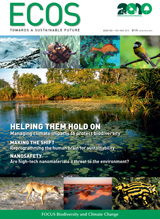
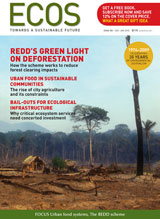
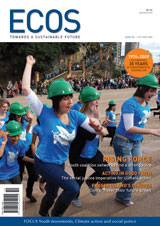
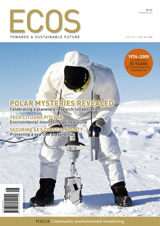
In this issue
 |
 |
ECOS
Issue 125
|
| |
|
|
Editorial - Editorial of an Issue
Blueprint planning for national coastal development
Responsibility for Australia's increasingly pressured coastal strip is shared by numerous jurisdictions, including local, state and commonwealth governments. This has made fundamental strategic planning for its sustainable development difficult to coordinate. Now, the CSIRO divisions of Land and Water, Marine Research, and Sustainable Ecosystems are working together to consider the challenge of a nationally coordinated strategic development plan.

Download Article

|
|
| |
|
Woodshed to power Britain
Melbourne-based alternative technology company, Woodshed Technologies, was recently granted a UK patent for a novel marine tidal energy system that can provide clean, reliable electricity. Together with two other Australian companies, it intends to co-develop British tidal energy facilities.
Download Article
|
|
| |
|
Tasmania's tourism future brightens
Tourism looks set to be a big beneficiary of Tasmania's new $250 million Community Forest Agreement package, announced by the Commonwealth and Tasmanian governments in May, to increase the state's reserves of old-growth forest.
Download Article
|
|
| |
|
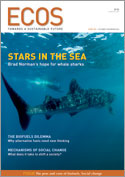
Threatened whale sharks draw calls to end exploitation
Eighty marine science experts from 23 countries, who attended an international marine conference in Perth during May, have issued a plea for countries to work more vigorously at protecting the unique, migratory whale shark – the largest fish in the world – and its global habitat areas.
Download Article
|
|
| |
|
A new vision for regional management
Aboriginal, political and community leaders from throughout northern Australia gathered in Innisfail in April this year to launch Caring for Country and Culture: The Wet Tropics Aboriginal Cultural and Natural Resource Management Plan. The initiative marks a new era in cooperative environmental management throughout Australia.
Download Article
|
|
| |
|
Misima Mines Ltd responds to island gold mine concerns
In issue 122, ECOS reported on the concerns being raised by Australian-based mining watch group the Mineral Policy Institute (MPI) over handling of allegedly significant environmental and socio-political impacts arising during the closure of the gold mining operation on Misima Island off mainland Papua New Guinea, owned by Placer Dome and PNG-based Oil Search Ltd. The operational joint venture company, Misima Mines Ltd, has refuted what it believes were false, unrepresentative assertions, and highlighted its case of a sound, fully inclusive, and standard-setting operational and closure process at the mine.
Download Article
|
|
| |
|
A burgeoning role for Aboriginal knowledge
Indigenous knowledge systems have developed over thousands of years through association with the variability of the environment. Their structures and application are quite unlike those of the modern scientific knowledge model. With such vast experience of environmental management, and time-tested alternative perspectives on the human place in the natural order, it is little wonder that Indigenous knowledge has a growing, cooperative role in natural resource management. Ecos spoke to three commentators about Aboriginal knowledge's relevance to sustainability thinking and practice in Australia.
Download Article
|
|
| |
|
Teamwork for a survey of sea country
Australia's expansive northern marine environment is relatively unknown to modern science. Now the coastal waters stretching from Kakadu National Park across Arnhem Land to the Gulf of Carpentaria and the Torres Strait are under the microscope – some for the first time. In a landmark initiative, Indigenous people have informed and taken part in a scientific survey of the region, the results of which are to become an integral baseline for cooperative management.
Download Article
|
|
| |
|
The green frontier
A new research tool for molecular genetics, hailed as the most important technology since the polymerase chain reaction in the early 1980s, is transforming research across the medical and biological sciences. Agriculture, the environment and people will be major beneficiaries as RNAi provides researchers with non-chemical ways of controlling pests and disease, increasing yields and delivering essential foods.
Download Article
|
|
| |
|
Closing the loop?
How are we faring as a nation when it comes to domestic and industrial recycling? What are its real environmental and economic impacts and are these measured? More importantly, should we really be doing more of it, and do recent technological advances mean that ambitious and much-vaunted Zero Waste targets can actually be achieved?
Download Article
|
|
| |
|
Garbage miners mean business
The intractable garbage that doesn't go into kerbside recycling bins – officially known as 'residual waste' – is at the heart of the waste disposal crisis, as it mounts up at landfill sites. Now, an Australian resource company has applied its skills in mining and process engineering to come up with a remarkable combination of tried-and-tested technologies from around the world to recover, with just one large facility, an extra 23 000 tonnes of valuable recyclable material a year from residual waste.
Download Article
|
|
| |
|
Metals: supremely recyclable
Re-use and recycling can help minimise fresh raw material inputs, waste outputs, and the manufacturing energy demands for most materials. Researchers at CSIRO Minerals, Mr Terry Norgate and Dr John Rankin, say that metals are proving prime candidates for reprocessing.
Download Article
|
|
| |
|
A fish farming salinity solution
It is a little disturbing that the inland waters of the Murray-Darling river system are so saline in places that marine species can survive. However, Research Leader for Aquaculture with the NSW Department of Primary Industries (DPI), Dr Geoff Allan, and his colleagues, see inland aquaculture as a logical alternative land use in salt degraded areas. This is especially so given the shortage of suitable sheltered deepwater fish-farming sites along the coast.
Download Article
|
|
| |
|
Sponging off the natural north
To meet strong global demand, researchers, Indigenous communities, governments and a private company are cooperating to set up a novel sponge farming industry in the warm marine waters off Arnhem Land and Torres Strait.
Download Article
|
|
| |
|
| |
|
|