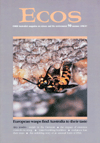
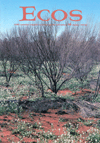
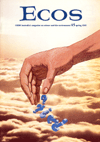
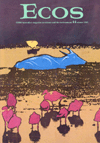
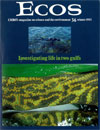
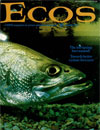
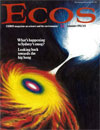
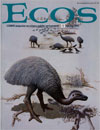
In this issue
 |
 |
ECOS
Issue 48
|
| |
|
|
Genetic engineering: the state of the art
It is only 43 years since Dr Oswald Avery and his colleagues at Rockefeller University in New York showed that DNA had some role in bacterial genetics and heredity. At the time it seemed a fairly unremarkable discovery, but in the intervening years, our knowledge about the pivotal role of DNA (deoxyribonucleic acid) in the development of all organisms has accelerated relentlessly.

Download Article
|
|
| |
|
Natural rubber industry for Australia?
According to a CSIRO report, Australia could become a significant producer of natural rubber from the Mexican desert plant guayule. Natural rubber continues to be in great demand for its unique properties, and the area of Australia that appears climatically suited to the shrub is large compared with that in other countries.
Download Article
|
|
| |
|
Solar signature from Australia's frozen past
Picture the hot dry Flinders Ranges in South Australia, and now try to imagine that landscape full of blue, icy-cold lakes and hard, frozen, treeless soil, perhaps like northern Canada. Such athletic feats of the imagination are routine for geologists. According to them much of South Australia was totally frozen in the late Precambrian era, some 680 million years ago.
Download Article
|
|
| |
|
Sun on skin: investigating the costs
Like so many chickens on a rotisserie, millions of Australians line the country's beaches every summer in their quest, often via severe sunburn, for a tan. But we are slowly beginning to realise that many pay a price for that million-dollar glow, caused by the ultraviolet (UV) radiation from the sun. Our country has the highest incidence of skin cancer in the world, with malignant melanoma, an often fatal cancer of the pigmented cells (melanocytes) in the skin, being twice as prevalent as it was a decade ago.
Download Article
|
|
| |
|
Butterflies give genetics a new dimension
Cabbage white butterflies breeding in a CSIRO laboratory have revealed unexpected behaviour of butterfly genes. The controversial conclusion is that genetic variation, far from being random, is restricted within fixed patterns.
Download Article
|
|
| |
|
Towards a bigger Milky Way?
Opposites may attract, but with the hold of gravity it is a case of like attracting like. This phenomenon extends into the realms of the large-scale structure of our universe. Stars are gravitationally bound to one another in individual galaxies, which themselves appreciate the company of others and group together in clusters of up to a thousand galaxies. These clusters, in turn, congregate in even larger aggregations to form superclusters.
Download Article
|
|
| |
|
Back from the brink
A small relative of the lyrebird, the noisy scrub-bird, created a stir in 1961 when - after some 70 years of presumed extinction - the male's loud penetrating song impinged once more on human ears.
Download Article
|
|
| |
|
Taming the roar of a gas flame
A small flame quivers in response to the melodious sound of a gently-bowed violin. An ear-splitting roar issues from a 1.5 megawatt industrial gas flame firing a reverberatory furnace. In both cases, the phenomena have similar physics, but we lack a satisfactory explanation of what's going on.
Download Article
|
|
| |
|
Jarrah's native pest
Jarrah is a valuable forest eucalypt. But for years this Western Australian tree has been under attack by a tiny grey moth, only millimetres long. The culprit is called Perthida glyphopa, or the jarrah leafminer, and is not, like so many other Australian pests, imported.
Download Article
|
|
| |
|
The choosy turtle
A turtle crawling out of the surf onto gleaming white sand seems to epitomise a tropical beach. Turtles must come up onto the sand to lay their eggs, which cannot develop in sea water, but how does mother turtle know which beach to choose?
Download Article
|
|
| |
|
| |
|
|