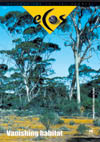
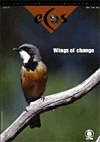
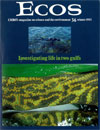
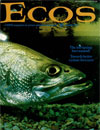
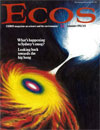
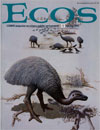
In this issue
 |
 |
ECOS
Issue 41
|
| |
|
|
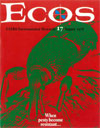
When pine and eucalypt meet
Its natural range is a mere 4000 hectares on the coast of California, but Pinus radiata has made the most of this modest beginning and now covers more than a million hectares of the globe. And this spread is largely due to mankind's intervention.
Download Article
|
|
| |
|
Soils shrink, trees drink, and houses crack
Each year in Australia, some 50 000 houses crack, accounting for about 80% of all housing insurance claims. Cracking may be caused by defects in building design and materials, or by inappropriate construction techniques. But, most often, soil movement is the cause.
Download Article
|
|
| |
|
Marine bacteria — more useful than we think?
Bacteria ... we are all familiar with these organisms that cause a long list of human maladies, ranging from infected cuts and scratches to bubonic plague. Yet, as agents of decay, they perform a vital role in the biological processes on this planet, recycling essential elements like carbon, nitrogen, and phosphorus from the dead to the living.

Download Article
|
|
| |
|
Termite colonies — castes of thousands
Not only the parlour floor, but bitumen, plastic- and lead-sheathed telegraph cables, inflated rubber tyres on vehicles, car batteries, and even ivory and billiard balls (not to mention living plants) have variously been nibbled at by northern Australia's giant termite Mastotermes darwiniensis.
Download Article
|
|
| |
|
Atlas maps our bird life
Since the arrival of Captain Cook in Australia, at least two bird species — the paradise parrot and a Tasmanian species of emu — have vanished forever. With increasing urban and pastoral development, the threat of extinction now faces other species, like the plains wanderer, the colourful orange-bellied parrot, and the freckled duck.
Download Article
|
|
| |
|
Simulating petroleum generation
Oil and natural gas take thousands or even millions of years to form from living matter deposited in sinking sedimentary basins. A vital ingredient in the process is heat: the fossilized organic material known as kerogen, formed from polymerized lipids, lignin, protein, and carbohydrates in decaying residues of biological material, needs to be subjected to temperatures above 130°C over a long period.
Download Article
|
|
| |
|
Fish on line
Australia's fishing zone almost equals the country's land surface area, making it the world's second largest national fishing zone. Yet our fishing industry is small, concentrating on a limited number of estuarine, coastal, pelagic (surface and mid-water), and demersal (bottom-living) fish that occur off the relatively densely populated north-eastern, south-eastern, and south-western coasts.
Download Article
|
|
| |
|
Shaky ground — or high tide?
Hundreds of years ago, when Galileo rose from his knees after formally recanting the Coperniean, cosmology, he is reported to have muttered under his breath 'Nevertheless, it moves'. Much earlier in history, Pliny the Elder stated in his 'Historia Naturalis' that at Cadiz, near the Temple of Hercules,'... there is a closed source similar to a well, which occasionally rises and falls with the ocean, but at other times does the opposite'.
Download Article
|
|
| |
|
| |
|
|