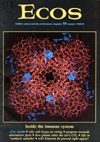
In this issue
 |
 |
ECOS
Issue 52
|
| |
|
|
New approach to entombing nuclear waste
Since the beginning of the nuclear age more than 40 years ago, intensely radioactive and thermally hot reactor waste has been steadily accumulating. Even the byproducts from the Manhattan Project, which led to the bombs that obliterated Hiroshima and Nagasaki, remain active at the Hanford Reservation within the State of Washington, USA. Scientists and engineers at the CSIRO Division of Geomechanics believe they have devised a particularly attractive way of doing this that offers clear benefits over existing proposals. They suggest that high-level nuclear waste should be buried as part of a thermosyphon loop, within which circulating groundwater would keep it cool and confined.
Download Article
|
|
| |
|
Mystery of the Antarctic ozone hole
Despite the probings of an American expedition sent to the Antarctic in the depth of last winter to try to settle the question, the cause of the 'ozone hole' in the stratosphere over Antarctica remains a mystery. The latest findings do not fit neatly into any existing theory, and are taxing the ingenuity of atmospheric scientists.
Download Article
|
|
| |
|
Investigating the causes of allergies
Are you one of those unfortunate people whose walk through a meadow full of grass and flowers is ruined by continuous sneezing and itchy eyes? If you eat strawberries or prawns, do you find your lips swelling, a headache developing, and your skin becoming red and itchy? Similar to allergies in some respects are food intolerances. One of the worst of these is coeliac disease, which affects an estimated 10,000 or so sufferers in Australia alone. People with this condition are unable to eat gluten, an umbrella term for a complex of about 40-50 different proteins found in wheat, rye, barley, and, to a lesser extent, oats.
Download Article
|
|
| |
|
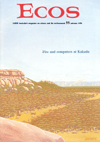
Prescription for Kosciusko
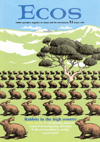
No livestock, no control burning, and no rabbits. That is the prescription for preserving subalpine environment, according to the results of an 8 year study in the Kosciuszko National Park, NSW.
Download Article
|
|
| |
|
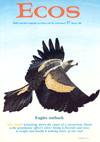
Birds: the Gondwana connection
Robins, wrens, flycatchers, warblers, and babblers - early European settlers gave some of our birds these names because they provided a reminder of similar birds back home. Birds of all these groups resemble those of the same name found in Europe or Asia. Of course, ours and theirs are different species, but because of similarities between the two groups, not only in obvious characteristics such as plumage but also in anatomy, biologists thought that they were closely related.
Download Article
|
|
| |
|
Trees catch a lot of rain
Poised on stainless steel cables, a patch of eucalypt forest containing 15 trees, has been weighed continuously for months at a time by hydrologists from the CSIRO Division of Plant Industry.
Download Article
|
|
| |
|
Martian winds and winters
The red planet has always exerted a powerful effect on the human imagination, perhaps because of the way in which its brightness can change so dramatically more than any other planet's, as orbital dynamics periodically bring the Earth and Mars close and then apart.
Download Article
|
|
| |
|
Pillared clay: a new breed of catalyst
As finite supplies of crude oil begin to dwindle, refineries will find they no longer have ready access to easily refinable light crudes. Instead they will have to use heavier types that are more difficult to process.
Download Article
|
|
| |
|
Tales from a dead submarine cable
A derelict submarine cable linking Australia to New Zealand can still tell us a thing or two. The old Morse-code carrier, laid in 1912, has been lying idle on the sea-bed since 1967. Oceanographers have recently studied small signals induced in the cable by ocean current moving about it.

Download Article
|
|
| |
|
| |
|
|