In this issue
 |
 |
ECOS
Issue 136
|
| |
|
|
Editorial: The pace of change
The Council of Australian Governments (COAG) has met again and followed through with some significant decisions on climate change adaptation measures, most of which were under-reported in the general media. These moves not only signal that the threat of climate change is now being fully acknowledged by government, but that the pace of commitment to counter measures has shifted too.

Download Article
|
|
| |
|
Reconnecting country at a landscape scale
Celebrations on either side of the continent have marked impressive developments for two visionary Australian landscape reconnection projects. Gondwana Link in south-west Western Australia and Kosciusko to Coast in New South Wales are vast collaborative projects that are securing a future for unique and threatened land, water and wildlife.
Download Article
|
|
| |
|
Mercury threat from fluorescents prompts call for recycling laws
While the Australian Government's move to phase out incandescent light bulbs in favour of compact fluorescent lamps (CFLs) by 2010 has been welcomed as an important initiative against global warming, concern has been raised that discarded fluorescent lights bring a new environmental problem - higher levels of poisonous mercury in landfill.
Download Article
|
|
| |
|
El Nino, Indonesian fires and pollution
While the link between El Nino and drought in eastern Australia is well established, recent NASA satellite and rainfall data suggest El Nino may also have boosted wildfire activity in Indonesia, adding to pollution levels over the Indian Ocean.
Download Article
|
|
| |
|
Council achievers have a global reach
Through a range of international campaigns and remarkably effective support programs, ICLEI has empowered local governments in 67 countries to engage business, industry, residents and wider levels of government to seize the sustainability initiative.
Download Article
|
|
| |
|
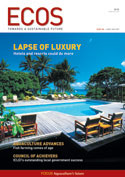
The lapse of luxury
With luxury hotels booming around the world, Matthew Brace reviews what this rapidly growing sector of the Australian tourism industry is doing to reduce its appreciable environmental impact, and educate its guests.
Download Article
|
|
| |
|
Winning nature photography
Stuart Miller, a Perth-based surgeon, started the ANZANG Nature landscape photography competition in 2004. A conservationist and photographer himself, he says he established the competition with the aim of encouraging greater public appreciation of the Australasian region's natural heritage.
Download Article
|
|
| |
|
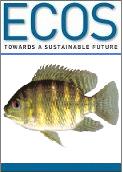
Aquaculture advances
In the past decade, aquaculture has become a $100 billion global industry - the fastest growing food-production sector since the advent of intensive agriculture in the 1950s. Australia's industry, while still relatively small, is setting high standards for quality, environmental rigour and innovative research.
Download Article
|
|
| |
|
Climate leaders: the new corporate standards
Being 'climate neutral' is rapidly becoming the new corporate standard and part of a broader movement to become more efficient and less polluting. Numerous organizations in Australia, large and small, have recently committed to this emergent international goal, making use of energy efficiency opportunities, greener power and a range of carbon offset schemes to achieve the negating of their calculated total climate impact.
Download Article
|
|
| |
|
Ocean management goes global
As climate change and overfishing take their toll on ocean ecosystems, an ambitious new project is underway to monitor physical ocean changes and track the movement and behaviour of sea creatures, on a global scale.
Download Article
|
|
| |
|
| |
|
|