In this issue
 |
 |
ECOS
Issue 137
|
| |
|
|
Editorial: Planning for contingencies
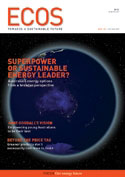
International research, including that by CSIRO, is showing that both greenhouse gas emissions and sea-level rise rates are currently tracking towards the upper end of IPCC projections. We lead this issue with a Focus on sea-level rise predictions and their implications for Australia over the next decades.
Download Article
|
|
| |
|
Using sewage and mining wastes to make arable land
According to the CRC for Contaminated Assessment and Remediation of the Environment (CRC CARE), Australia's 13 million tonnes of fly ash from power generation, an even larger amount of 'red mud' from bauxite processing and millions of tonnes of bio-solids from urban sewage systems are all potential ingredients for artificial soils.

Download Article
|
|
| |
|
Millions allocated to Micronesia to meet climate change challenge
As part of a US$100 million commitment to island conservation and reducing the impact of climate change, the Global Environment Facility (GEF) has committed US$6 million to the Micronesia Challenge, a landmark conservation initiative in the Northern Pacific to effectively conserve 30 per cent of marine resources and 20 per cent of terrestrial resources by 2020.
Download Article
|
|
| |
|
A legend lives on in the salty West
An enthusiastic volunteer organisation in Western Australia is helping farmers put trees back into the landscape and combat salinity. Where Men of the Trees differs from many other environmental organisations, however, is that its dedicated members follow an inspiring international precedent set by a man ahead of his time.
Download Article
|
|
| |
|
The benefit to the economy of early climate change action
Climate change policy debates have been preoccupied with the economic cost of taking action to reduce greenhouse gas emissions. Yet recent assessments have reframed the question, focusing instead on the cost of inaction. In fact, the damage caused by unmitigated climate change may be the bigger threat to the global economy.
Download Article
|
|
| |
|
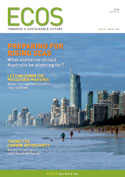
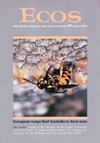
Preparing for sea-level rise
Around the world sea-level rise is already making an impact, and expectations are that it's going to get worse. With about 6 per cent of addresses occurring within 3 km of the coast, Australia is vulnerable to the various threats higher sea levels pose. However, mixed media coverage and scientific uncertainty over critical glaciological processes have seen a range of sea-level projections reported – from centimetres to metres – by 2100. So what sort of sea-level rise should we prepare for, and how is Australia planning to mitigate the inevitable impacts?
Download Article
|
|
| |
|
Letting down the marshes
The demise of the Macquarie Marshes in NSW, an internationally significant wetland, highlights a critical breakdown in habitat management across vested interests and the price of prioritising water extraction for commercial use above environmental allocations.
Download Article
|
|
| |
|
Business challenged to make its own path to carbon rewards
Trail-blazers from organisations on the leading edge of sustainable practice came together at the recent Business Leaders Forum on Sustainable Development in Brisbane to present an overview of the imperatives for our community in the new 'carbon economy'. They once again challenged business in Australia to quickly forge its own lead, and to realise the opportunities ahead.
Download Article
|
|
| |
|
Improving performances in the boardroom
True to global research, companies that value their intangible assets and pay regard to the social, environmental and community issues that ultimately matter to stakeholders are now registering above-average financial performance. This is being reflected by Socially Responsible Investment Funds in Australia outperforming the ASX200.
Download Article
|
|
| |
|
A call for tougher groundwater management
Amid one of Australia's worst droughts, the understanding and efficient management of groundwater supplies and their use has taken on a new urgency. Ageing metering infrastructure and weak guidelines on allocations and policing have led to profligate and illegal extraction. But new efforts to change this are underway. Strong policy action is now needed to see the tougher measures through.
Download Article
|
|
| |
|
Smart fishing sets a standard in NZ
New Zealand has a regulatory framework to protect the marine environment against human assaults and is now using a unique management model developed by Aotearoa Fisheries Limited to construct a sustainable crab fishing industry from scratch.
Download Article
|
|
| |
|
| |
|
|