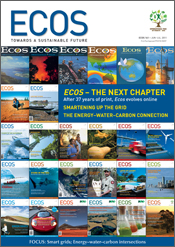
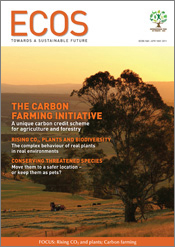
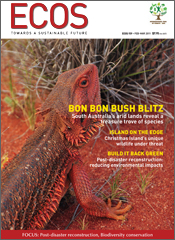
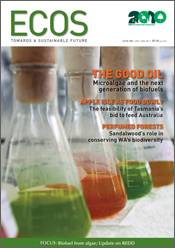
In this issue
 |
 |
ECOS
Issue 139
|
| |
|
|
Editorial: Micro power makes sense
'Mega' solutions are not necessarily the best approach to large-scale environmental problems. In fact, as our story on page 4 demonstrates, the solution to one of South-East Asia's, and the world's, biggest vehicle pollution problems – the millions of two-stroke motorcycle and tricycle engines belching fumes into the atmosphere – can be as simple as a low-cost engine retrofit.
Download Article
|
|
| |
|
Oz 'carbon aid' for Asia-Pacific forestry
Australian scientists are training foresters in Asia-Pacific countries to measure carbon storage in trees, enabling these nations to gauge their contribution to achieving carbon targets and to participate in carbon trading markets.
Download Article
|
|
| |
|
Thinner, clearer, cheaper solar panels
Critics of photovoltaic (PV) technology have pointed to its high cost relative to other renewable energy technologies. However, US company NanoMarkets has forecast a 75 per cent decrease in cost over the next decade due to developments in thin-film PV (TFPV) technology.
Download Article
|
|
| |
|
Beyond the price tag: the costs and benefits of going green
Today it's not enough for manufacturers to make the cheapest or best-quality on the market if the product, or its production, use and disposal leave a big environmental footprint. Product stewardship requires key stakeholders to share responsibility for product impacts – an idea that's slowly catching on in Australia.
Download Article
|
|
| |
|
The many dimensions of sustainable development
Everyone seems to be talking about sustainability. But are we all on the same wavelength when we use the term? Steve Hatfield Dodds – senior CSIRO researcher and President of the Australia New Zealand Society for Ecological Economics – begins a series examining the meaning behind this often-invoked word.
Download Article
|
|
| |
|
The solar generation sets sail
Over recent months, teams of school students throughout the eastern states have been designing and building their entries to compete in the second International Solar Boat Challenge.
Download Article
|
|
| |
|
No time to lose
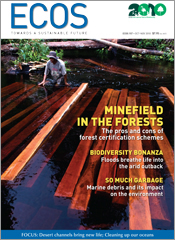
In his latest book, On Borrowed Time, leading Australian ecologist Professor David Lindenmayer writes that biodiversity loss is 'the most significant environmental problem facing Australia'. In fact, he continues, we are 'in the midst of the planet's sixth great extinction event', now being driven at alarming speed by human intervention. This edited extract highlights two of the 10 key environmental problems facing Australia.
Download Article
|
|
| |
|
ANZANG 2007 winners captured in print
Short-listed and winning entries from the 2007 ANZANG (Australia, New Zealand, Antarctica and New Guinea) Nature photography competition – the most prestigious of its kind in the Australasian region – have been brought together in a new book published jointly by ANZANG and CSIRO Publishing.
Download Article
|
|
| |
|
Keeping birds off the radar
They've been blasted with noise, even shot at, but birds – common and endangered – seem to gravitate to airports, creating a flight hazard. New Zealand authorities are looking at two low-impact solutions to the bird-strike problem.
Download Article
|
|
| |
|
Heart of gold
Waiting around for someone else to do something about the reduction of greenhouse gases is not on the agenda for this highly motivated community group in central Victoria.
Download Article
|
|
| |
|
Review - Taking a stand on deep-sea conservation
If you're looking for a cause, now is the time to stand up for the deep ocean. This cold and dark world of continental slopes, mid-basin ridges and ocean floor plains is in need of advocates – more people, scientists and governments willing to show their hand for 'the silent deep', as Tony Koslow describes it, and support the precautionary principle of conservation.

Download Article
|
|
| |
|
DIY billabongs to protect farm biodiversity
Thanks to an innovative community organisation known as the Birchip Cropping Group, farmers in Victoria's north-west Wimmera Mallee region are being encouraged to establish low-cost wildlife ponds on their farms, to help maintain biodiversity as the area replaces its open channels with pipes.

Download Article

|
|
| |
|
| |
|
|